
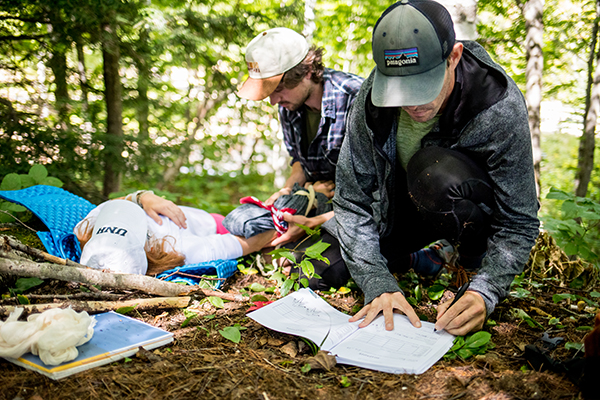
Provided by EH&S in collaboration with UCLA Recreation
Learn More about Field Research Safety
This two‑day course is designed to teach essential first aid principles and hands‑on skills for responding to illnesses, injuries, and environmental hazards in situations where emergency medical services (EMS) may be delayed or unavailable.
This training is ideal for anyone working in wilderness or remote environments, as well as those preparing for urban settings affected by natural disasters such as earthquakes or hurricanes.
- 2026 October 10 - 11 - Class full
- 2027 February 6 - 7
- Register Now
- Total course duration: 16 hours over 2 days
- Breaks will be taken periodically throughout the course
- For full‑day sessions (8–9 hours), a 1‑hour lunch break will be scheduled midday
- Participants are encouraged to bring their own lunch, as there are no nearby options for quick or convenient food purchases
This course is usually held at UCLA’s Sunset Canyon Recreation Center (SCRC)
- 111 Easton Drive, Los Angeles, CA 90095, inside the Mesa Room.
- Individual course sessions may be scheduled at different locations. The planned location will be emailed to your after registrrations.
- Adult CPR/AED - proof of certification prior to beginning the course is required. Certification from any organization is accepted.
- If you do not have your certifications let us know when you register and we will assist with this.
- Definition of wilderness and remote setting
- Primary patient assessment procedure
- Secondary patient assessment procedure
- Calling for help and evacuation considerations
- Shock and heart attack
- Chest injuries
- Head, neck, and spinal injuries
- Wounds and wound infection
- Bone and joint injuries
- Burns
- Abdominal illness
- Hypothermia
- Heat-related illness
- Lightning
- Altitude illness
- Submersion incidents
- Allergies and anaphylaxis
- Notebook and pencil or pen
- Personal bottle of hand sanitizer
- Watch with a second hand or digital second
- Sunglasses and/or protective eyewear
- Water bottle
- Personal snacks
- Lunch (for courses that take place all-day; there are no nearby option where one may easily/quickly purchase food)
- Headlamp (if course take place outside of daylight hours)
- Close-toed, sturdy shoes, such as light hiking boots, sneakers, or athletic shoes
- Clothing layers that allow you to be comfortable in a variety of weather conditions, including a hat
- Optional: personal camping and first aid supplies that you typically carry, such as a sleeping bag, ground pad, hiking pole, extra layers, and your own first aid supplies. You may opt to use your own equipment when practicing responding to scenarios.