
Battery waste is a significant environmental issue. Discarded batteries can release toxic heavy metals (i.e. lead, mercury, cadmium) into landfills, polluting soil and water, and can cause fires in waste facilities, endangering lives and costing millions. In order to ensure these are disposed of safely our EH&S Hazardous Waste Program provides collection and recycling services for on campus departments.
Batteries submitted with no paperwork or incorrectly prepare will be return to customer.
- Request a collection box with a fire suppression liner from EH&S for free, these are for universal waste which routine household batteries (i.e. AA, AAA, C cells, D cells, 9-volt, button batteries).
- For all other specialty or larger batteries (lead acid) email us, keep the items to the side, and we can pick them up as soon as possible.
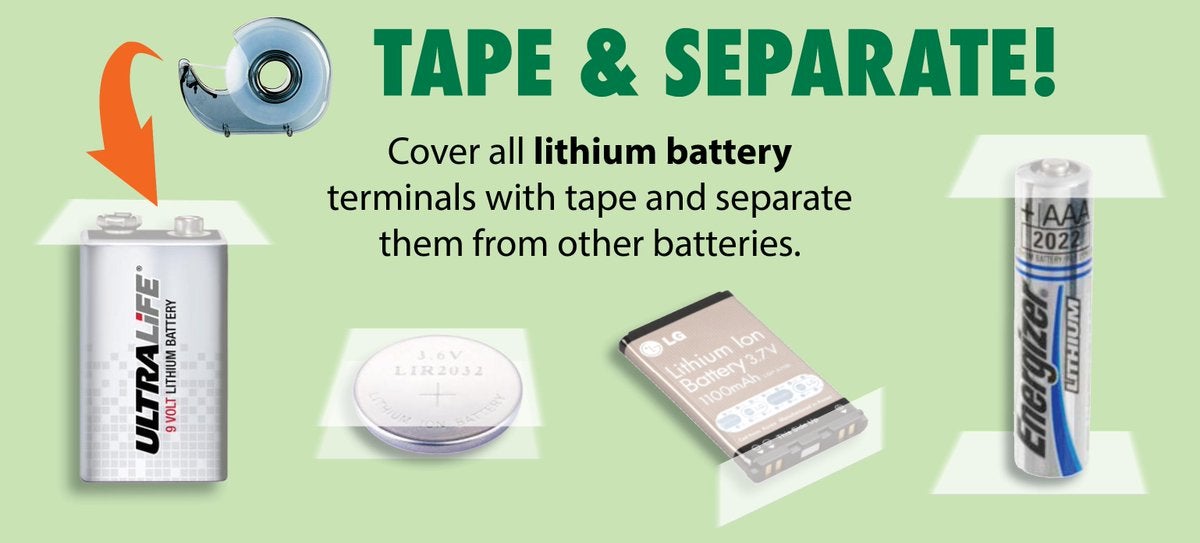
- Tape all lithium battery terminals with non-conductive clear tape or individually bag each battery.
- Note: Lithium batteries may spark and cause fires if damaged or the terminal ends touch. For any fires call 911!
- Submit a Battery Collection Request Form
- Print your request to bring to our pick up location
- If pick up location not listed below, we will email you with a location and pick up time.
Day Time Pickup Location 2nd Monday of month 9:30 a.m. - 10:00 a.m.Boyer Hall Loading Dock2nd Monday of month 10:15 a.m. - 10:45 a.m.Physics Receiving2nd Monday of month 11:00 a.m.- 11:30 a.m.Psychology Loading DockTuesday 9 a.m. - 10:00 a.m.MSB Loading Dock Tuesday 10:30 a.m. – 11 a.m.Gonda Loading Dock Wednesday 9:00 a.m. - 9:30 a.m.Engineering IV ReceivingWednesday 9:45 a.m. - 10:15 a.m.TLSB Loading DockWednesday 10:30 a.m. - 11 a.m.CHS B Level Loading DockThursday 9:30 am. - 10:00 a.m.CHS B Level Loading DockThursday 10:15 a.m. - 10:45 a.m.Engineering IV ReceivingThursday 11 a.m. - 11:30 a.m.CNSI Loading DockFriday 9 a.m. - 10:00 a.m. MSB Loading Dock Friday 10:15 a.m.- 10:45 a.m. BSRB/OHRC Loading Dock
The EH&S hazardous waste program will only accept and replace you brown battery collection bins until June 30, 2026.
After June you will be charged an additional processing fee to sort and tape these batteries of $50/ brown bin submitted.
To get the new collection box with a fire suppression liner for no additional cost email: EH&S hazardousmaterials@ehs.ucla.edu
| Battery Type | Cost |
|---|---|
| Collection Box with Fire Suppression Liner | $ 0 / box |
| Universal waste batteries ( Household batteries e.g. AA, AAA, C, D, Rechargeable ion) | $ 0.00 |
| Specialized batteries - not routine household batteries | $ request quote |
| Brown Collection Bin Processing - after June 2026 | $ 50 / bin |
For more information on what is Universal Waste - Batteries visit CA DTSC Resource Page
Battery Formats or Types:
- Alkaline and zinc-carbon batteries include 9 Volt, AA, AAA, C, D and some button cells.
- These small, round batteries have historically contained silver, cadmium, mercury or other heavy metals as their main component.
- Button cells or coin containing lithium metal must have non-conductive clear tape around the entire button/coin.
- These common batteries are made with lithium (Li) metal and are single-use and non-rechargeable. They include 9 Volt, AA, AAA, C, D and some button cells.
- These batteries are typically used in cordless power tools, cordless phones, digital and video cameras, two-way radios, bio-medical equipment and video cameras.
- They may look like single-use AA, AAA or other alkaline batteries or a battery pack shaped for specific tools.
- Commonly found in cellphones, power tools, digital cameras, laptops, children’s toys, e-cigarettes, small and large appliances, tablets and e-readers.
- Some Li-ion batteries are not easily removed from the product and can become problematic as a fire hazard if they are broken, bent or crushed
Commonly found in cellphones, cordless power tools, digital cameras and two-way radios.
Commonly found in digital cameras, wireless keyboards and small electronics.
- Commonly found in mobility scooters, children’s toy cars, emergency lighting and hospital equipment. Also used for backup power in residential landline phones and uninterruptable power supplies for computers.